Choose one permitted, quiet place. Keep the same camera and editing approach throughout. Changing fewer things makes your comparisons more useful.
The timings below are suggested limits, not a performance target. If the location becomes busy, pause or leave. Your own entryway is a valid subject. There is no need to find a famous or dangerous location.
018 MINUTES · 3 FRAMES
Find your standing point.
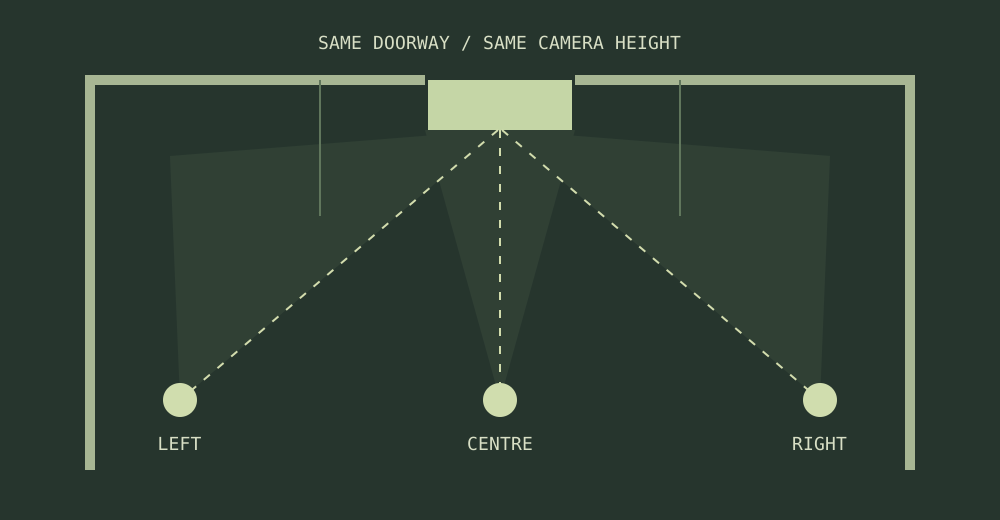
Choose a doorway or route as your anchor. Photograph it from the centre, a step to the left and a step to the right. Keep the camera at the same height and aim at the same anchor. Do not zoom between frames.
Original composition diagram · top-down plan, not a photograph
Compare: which version separates the edges most clearly? Which one makes the next space feel least resolved? Those may be different frames.
KEEP: one frame + one sentence about your position.
026 MINUTES · 2 FRAMES
Make absence visible.
Find one trace of routine: a row of chairs, a mat or a place where objects are normally stored. Make a frame that includes it. Make another from the same position with a tighter crop that excludes it.
“
The empty space feels like a place for ______ because I can still see ______.
Compare: show the pair to yourself at thumbnail size. Does the trace help identify the room’s purpose, or distract from the route? Keep the version that supports your intended question.
KEEP: a before-and-after pair; label the crop change.
038 MINUTES · 3 FRAMES
Follow the light.
Choose an existing pool of light or bright opening. Make your baseline exposure. If your phone allows it, make a slightly darker and a slightly brighter version without changing position.
DARKER
BASELINE
BRIGHTER
Schematic brightness swatches, not photographs or a simulation of a particular camera.
Compare: can you still see the doorway’s edge? Are the shadow surfaces readable? Pick the frame where the important shapes survive. Darkest is not automatically strongest.
KEEP: one frame + a note on the detail you protected.
048 MINUTES · 1 SEQUENCE
Build a tiny sequence.
Choose three images from your set: one to introduce the room, one to guide the eye along a route, and one to leave the destination open. Try that order, then reverse it.
THE PLACE→THE ROUTE→THE QUESTION
Compare: does reversing the order change which frame feels like an ending? If all three do the same job, remove one. A pair with a clear relation can be more useful than a repetitive set.
KEEP: a two- or three-frame sequence with literal captions.
AFTER THE WALK
Keep a note. Build an eye.
Write three short lines alongside your original files. Use observations you can act on next time.
WHAT CHANGED“Moving left separated the door from the window.”
WHAT DIDN’T HELP“The darker version hid the floor seams I needed.”
WHAT I’LL REPEAT“Next time, I’ll compare camera height before cropping.”
Review without a scoring system.
Choose your strongest frame because you can explain what it does. Is the place recognisable? Is there an anchor for your eye? Does the image leave something open without hiding everything? These questions are more useful than deciding whether it is “liminal enough.”
You can repeat the assignment in the same place on another permitted visit. Keep a similar standing point and notice what changed naturally: the light, the open door, the objects in use. Do not alter a location to recreate someone else’s image. Your comparison is the work.